COVID-19 Detection Using Transfer Learning: A Deep Learning-Based Image Classification Approach
🧠 Introduction
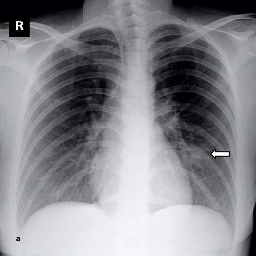
The COVID-19 pandemic highlighted the critical need for rapid and accurate diagnostic tools. Chest X-ray imaging can aid in early COVID-19 detection, but manual diagnosis is time-consuming and requires expert radiologists. This project explores a deep learning approach using transfer learning to automatically classify COVID-19 cases from chest X-ray images.
📌 Problem Statement
The objective of this project is to develop a reliable image classification model to detect COVID-19 from chest X-ray images using transfer learning techniques. The model distinguishes between different classes such as COVID-19 and Normal.
🧾 Dataset
- Source: Open-source COVID-19 X-ray datasets
- Classes: COVID-19, Pneumonia
- Format: JPG/PNG images with varying resolutions
- Preprocessing & Data Augmentation:
- Normalization: Pixel values rescaled to [0,1] range (rescale=1.0/255.0)
- Geometric Augmentation:
- Random rotation up to 40 degrees
- Width and height shift up to 20%
- Shear transformation up to 20%
- Zoom range up to 20%
- Horizontal flip for better generalization
- Color Augmentation:
- Brightness variation between 80% and 120%
- Channel shift range of 0.1 for color variation
- Fill Mode: Nearest neighbor interpolation for filling pixels after transformations
🚀 Methodology
Transfer Learning Approach
This project implements a two-stage transfer learning approach using the VGG16 pre-trained model:
- Feature Extraction Stage: Freeze all VGG16 layers and train only custom classifier layers
- Fine-tuning Stage: Unfreeze the last 6 layers of VGG16 for domain-specific adaptation
Model Architecture
- Base Model: VGG16 pre-trained on ImageNet (without top layers)
- Input Shape: 244×244×3 pixels
- Custom Classifier:
- GlobalAveragePooling2D layer
- Dense layer (512 units, ReLU activation, L2 regularization)
- Dropout layer (0.5 rate)
- Dense layer (256 units, ReLU activation, L2 regularization)
- Dropout layer (0.3 rate)
- Output layer (1 unit, sigmoid activation for binary classification)
🔧 Implementation Details
Training Strategy
Stage 1 - Feature Extraction (10 epochs)
- All VGG16 layers frozen
- Learning rate: 1e-4
- Focus on training custom classifier layers
Stage 2 - Fine-tuning (20 epochs)
- Last 6 VGG16 layers unfrozen
- Reduced learning rate: 1e-5
- Fine-tune pre-trained features for medical imaging domain
Advanced Techniques
- Regularization: L2 regularization (0.001) and Dropout layers to prevent overfitting
- Callbacks:
- Early Stopping (patience=5) to prevent overfitting
- ModelCheckpoint to save best performing model
- ReduceLROnPlateau for adaptive learning rate adjustment
- Cross-validation: 5-fold Stratified K-Fold for robust evaluation
📊 Results & Performance
Model Performance
The two-stage training approach demonstrated significant improvements:
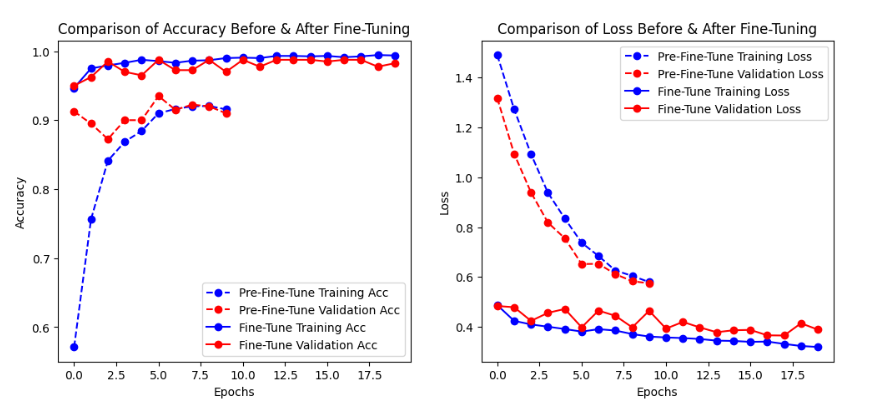 Comparison of accuracy and loss curves before and after fine-tuning showing improved convergence and performance
Key Performance Highlights:
- Stage 1 (Pre-Fine-Tune): Model achieved baseline performance with frozen VGG16 features
- Stage 2 (Fine-Tuning): Significant improvement in both training and validation accuracy
- Convergence: Faster convergence and higher final accuracy after fine-tuning
- Stability: Reduced loss oscillation and more stable training curves
Evaluation Metrics
- Accuracy: Comprehensive evaluation on validation dataset
- Confusion Matrix: Detailed analysis of true positives, false positives, etc.
- Classification Report: Precision, recall, and F1-score for each class
- Training Curves: Visualization of accuracy and loss progression across both training stages
Detailed Performance Results
Final Model Accuracy: 99.0%
Confusion Matrix:
1
2
3
4
                    Predicted
                COVID-19  Normal
Actual COVID-19    196      4
    Normal          1      199
Classification Report:
1
2
3
4
5
6
7
8
              precision    recall  f1-score   support

           0       0.99      0.98      0.99       200
           1       0.98      0.99      0.99       200

    accuracy                           0.99       400
   macro avg       0.99      0.99      0.99       400
weighted avg       0.99      0.99      0.99       400
Performance Analysis:
- Precision: 99% for COVID-19 class, 98% for Normal class
- Recall: 98% for COVID-19 class, 99% for Normal class
- F1-Score: 99% for both classes
- False Positives: Only 4 normal cases misclassified as COVID-19
- False Negatives: Only 1 COVID-19 case misclassified as normal
- Total Misclassifications: 5 out of 400 samples (1.25% error rate)
Key Insights
- Transfer Learning Effectiveness: Pre-trained VGG16 features significantly accelerated convergence
- Two-Stage Training Benefits: Feature extraction followed by fine-tuning provided optimal results
- Data Augmentation Impact: Aggressive augmentation improved model generalization
- Regularization Importance: L2 regularization and dropout prevented overfitting on medical images
🏗️ System Architecture & Deployment
Beyond the core deep learning model, this project was architected to be a production-ready solution. We moved beyond a simple notebook experiment by wrapping the model in a high-performance API and containerizing the entire application.
High-Performance API with FastAPI
To serve the model, we utilized FastAPI, a modern web framework for building APIs with Python. Unlike traditional frameworks, FastAPI is designed for speed and ease of use, making it an ideal choice for real-time inference.
The system exposes a robust /predict endpoint that handles the complete inference pipeline:
- Image Preprocessing: Incoming X-ray images are automatically resized and normalized to match the VGG16 input specifications.
- Inference: The model processes the image to generate a prediction.
- Confidence Scoring: Instead of a simple binary output, the API returns a detailed probability distribution (e.g., 98.5% COVID-19, 1.5% Normal). This confidence score is crucial in medical contexts, providing clinicians with transparency regarding the model’s certainty.
Docker Containerization
To ensure consistency across different environments—from development machines to production servers—the entire application is Dockerized. By packaging the model, dependencies, and API server into a single isolated container, we eliminated compatibility issues. This approach offers:
- Seamless Deployment: The container can be deployed anywhere Docker is supported, ensuring the application runs exactly as intended.
- Scalability: The architecture supports horizontal scaling, allowing multiple container instances to handle increased inference loads.
- Reproducibility: The exact environment is preserved, ensuring reliable and reproducible performance.
💻 Technical Stack
- Deep Learning: TensorFlow/Keras
- Pre-trained Model: VGG16 (ImageNet weights)
- Data Processing: ImageDataGenerator for augmentation
- Evaluation: Scikit-learn metrics
- Visualization: Matplotlib for performance analysis
- Backend: FastAPI
- Deployment: Docker
🔗 Project Repository
📁 GitHub Repository: COVID-19-Detection-Transfer-Learning
Complete source code, dataset preparation scripts, and trained model weights available in the repository.
🎯 Key Takeaways
- Transfer Learning Power: Leveraging pre-trained models significantly reduces training time and improves performance on medical imaging tasks
- Two-Stage Training: Feature extraction followed by selective fine-tuning optimizes performance
- Data Augmentation: Aggressive augmentation is crucial for medical image classification with limited datasets
- Model Evaluation: Comprehensive evaluation using multiple metrics ensures reliable performance assessment
This project demonstrates the practical application of transfer learning in medical AI, showcasing how pre-trained models can be effectively adapted for COVID-19 detection from chest X-rays.